One core change, every adapter.
Message formats, field lengths and batch windows change on the core banking system's schedule, and every connected adapter needs the change applied and contract-tested. Here is how Flowmynt holds the whole fan-out as one run so no adapter is discovered late.
- Industry
- Banking
- Flowmynt product
- Flowmynt Connect
- Deadline set by
- Your core banking release
- Stays with you
- Release window, change approval, cutover
A core banking change ripples through every adapter that reads the changed structure. Formats, field lengths and batch windows move on the core system's schedule, and each connected adapter needs the change applied and proven against its contract.
The real cost is tracking which adapters are affected and keeping each one's evidence straight. Adapters fail quietly: a field truncation surfaces days later as a customer-facing defect or a broken batch.
Why adapters fail quietly
A missed adapter is not found in testing. It is found by a customer, or by a batch job that stops at three in the morning.
The core release window is fixed by someone else, and the change advisory board wants to see per-adapter evidence, not a single green build.
What you send us
The core change notice and the contract tests that define correct behaviour for each interface.
Flowmynt finds the affected surface itself: every adapter, message and batch job that reads the changed structure.
How the fan-out is handled
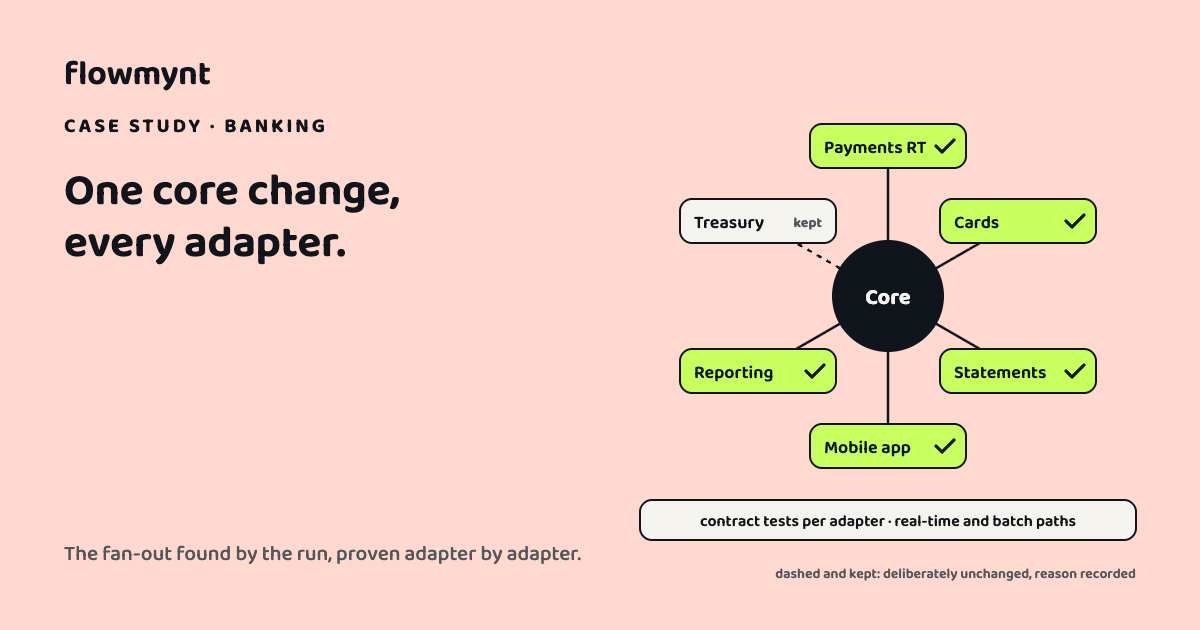
The whole fan-out is one run. The affected surface is found by the run rather than by memory, independent adapters move in parallel, dependent ones wait for their predecessor, and every adapter carries its own contract test result to the change advisory board.
Map the fan-out
Every adapter, message and batch job that reads the changed structure is identified, and each becomes a unit of the same run.
Sequence
Independent adapters are built in parallel; dependent ones are held until their predecessor is accepted.
Build inside your codebase
The change is applied against each existing interface contract on its own branch.
Independent review
Each adapter change is reviewed separately by someone who did not implement it.
Prove
Contract and integration tests run across real-time and batch paths, and acceptance is computed per adapter from that evidence.
Cut over
Adapters are released inside your core release window, with the ones deliberately left unchanged recorded with their reasoning.
What the change board sees
The change board sees the whole surface, including what was deliberately left alone, before anything moves.
- One reviewed change per adapter, each carrying its own contract test result.
- A dependency map of what the change actually reached, produced by the run rather than drawn by hand.
- Interfaces deliberately left unchanged, with the reasoning recorded against the run.
What the bank decides
Flowmynt applies and proves the change. The core release window, change advisory approval and the moment of production cutover stay with the bank.
- The core release window.
- Change advisory approval.
- Production cutover.
Where this lives in Flowmynt
Flowmynt Connect is the adapter layer: every bank, issuer, verification service and messaging channel sits behind one contract with its own contract tests. A core change is applied once, at the adapter, and proven there.
Flowmynt Build is the same engineering discipline applied inside your codebase when the adapters are yours: isolated branches, independent review and evidence per interface.
Source pattern: core integration adapters, Exekova banking use cases
Is a core release coming?
Send the change notice and your contract tests. Flowmynt replies with the mapped fan-out and a per-adapter plan to your release window.
Talk to Flowmynt