A provider retires an API. Your payouts keep moving.
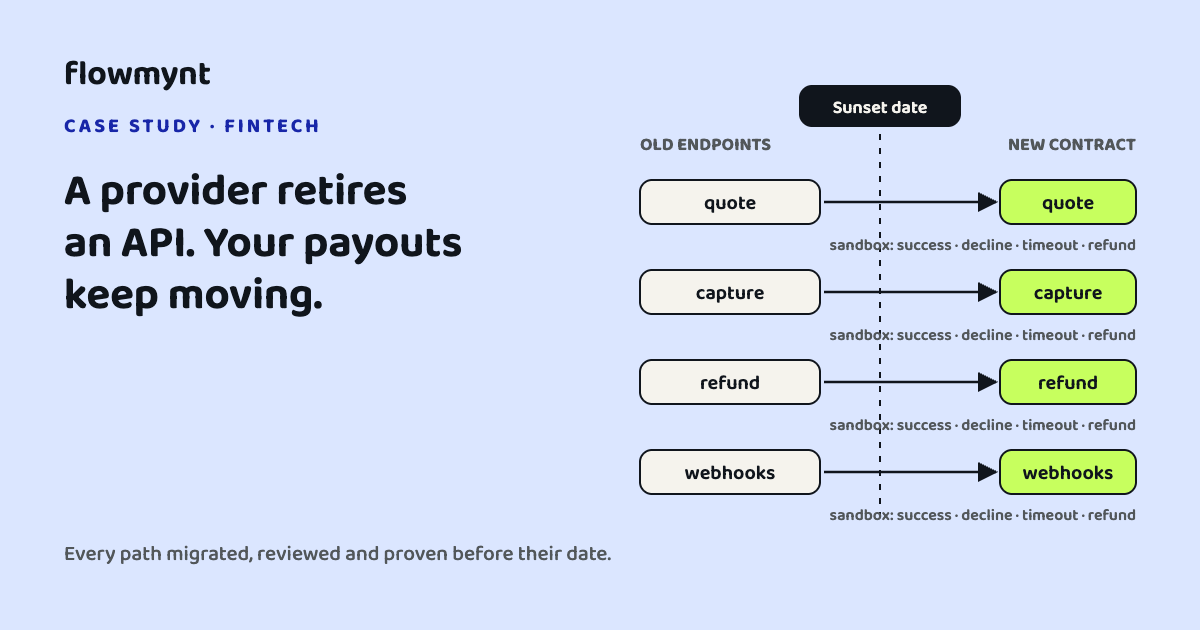
A payment provider sets a sunset date for the endpoints your quote, capture, refund and webhook paths depend on. Here is how Flowmynt migrates every path as one run, with sandbox evidence for each response case.
- Industry
- Fintech
- Flowmynt product
- Flowmynt Connect
- Deadline set by
- Your payment provider
- Stays with you
- Contract terms, cutover window, deploy approval
A payment provider announces that the endpoints behind quote, capture, refund and webhooks will stop on a date of their choosing. The date is on their calendar, not yours. Missing it does not degrade payments. It stops them.
The engineering is rarely hard. What makes these migrations slip is finding every call site, including retries and webhook handlers, and keeping evidence for each path so the cutover can be defended afterwards.
Why the date matters
Breaking changes from a provider land across several paths at once, and each path has its own response cases: success, decline, timeout and refund. A migration that tests the happy path and ships is the one that fails at month end on a refund nobody re-ran.
The deadline is externally fixed. A missed sunset is not a sprint slip; it is a transaction outage that your customers notice before you do.
What you send us
The deprecation notice and the affected endpoints. Sandbox credentials for the new contract. Your definition of done for a migrated path, which becomes the acceptance standard for every unit of the run.
You do not hand over a task breakdown. Flowmynt maps the surface itself.
How the migration runs
A migration slips when it is run as a list of tickets. Flowmynt runs it as one piece of work with a fixed shape: map the surface, sequence the paths, build each on its own branch, review each independently, prove each against the sandbox, then cut over when you say so.
Map
Every call site that touches the deprecated endpoints is found, including retries, background jobs and webhook handlers. Each becomes one unit of the same run, so nothing is discovered late.
Sequence
Independent paths are built in parallel. Paths that depend on each other are held until their predecessor is accepted, rather than one engineer working through a list.
Build inside your codebase
Each path is implemented against the new contract on its own isolated branch in your repository, under the permissions you granted, so the change is reviewable on its own.
Independent review
A reviewer who did not write the change reviews the diff for each path, with the reproduction and the contract attached.
Prove
The provider sandbox is run across success, decline, timeout and refund for every path. Acceptance requires evidence for each response case, kept with the run.
Cut over
The cutover happens in the window you set, with the old paths retained until you approve their removal.
What lands in your repository
The deliverable is not a green build. It is a set of records you can hand to the provider, your auditor or the engineer who joins next quarter.
- A reviewed pull request per migrated path, not one large change nobody can review.
- Sandbox evidence for each response case, retained against the run as one record.
- Call sites deliberately left on the old version, with the reason recorded against each.
Your calls
Flowmynt does not sign contracts with your provider or choose when your customers see a change. Those decisions are surfaced with the facts, and made by you.
- Provider contract terms and the commercial relationship.
- The cutover window.
- Production deploy approval.
Where this lives in Flowmynt
Flowmynt Connect puts every provider behind one contract for quotes, payments, refunds and status events. When a provider retires an API, the migration is an adapter change with contract tests, not a search through every product for the calls that broke.
The same shape applies to the provider you connect for WhatsApp payments, cross-border payouts or card issuing: the adapter changes, the customer journey and your operating views do not.
Source pattern: provider API deprecations, Exekova fintech use cases
Facing a sunset date?
Send the deprecation notice and the endpoints it names. Flowmynt replies with the mapped surface, the run plan and a fixed price for the migration.
Talk to Flowmynt