Reconciliation breaks stop ageing.
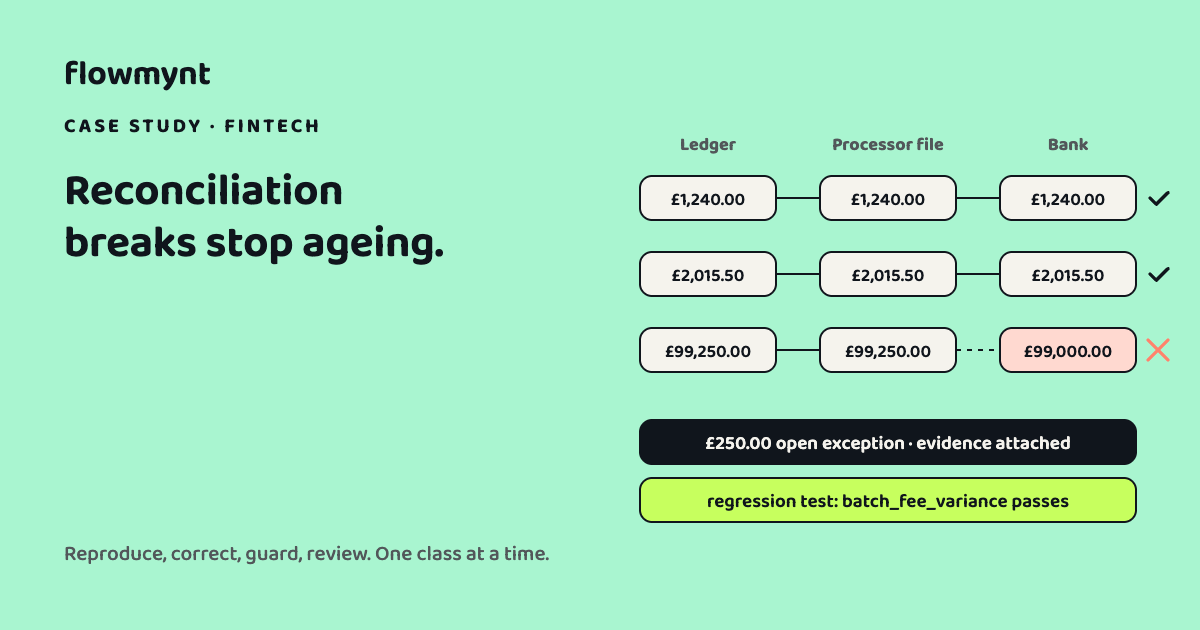
Mismatches between your ledger, the processor file and the bank statement are usually small logic gaps, but each needs reproducing before it can be fixed. Here is how Flowmynt drains the queue: reproduce, correct, guard and review inside one run.
- Industry
- Fintech
- Flowmynt product
- Reconciliation
- Deadline set by
- Your finance calendar
- Stays with you
- Accounting treatment, restatements, remediation
A mismatch between what your ledger says, what the processor file says and what the bank statement says is usually a small logic gap: a mapping, a rounding rule, a timing window, a duplicate event. Each one needs reproducing from real settlement data before anyone can fix it, and that reproduction is the bottleneck.
While the queue waits for someone to reproduce it, the items age. Unreconciled positions become finance escalations, and in a regulated entity they become reportable control findings.
Why the queue ages
Reconciliation exceptions arrive faster than a team can reproduce them, because reproduction needs redacted samples, a sandbox and time nobody has on the day the file lands.
The cost is not the fix. It is the month-end close that slips because the same exception class keeps coming back, quietly closed without a test that proves it stays closed.
What you send us
An exception class from your reconciliation queue with sample identifiers, and the ledger behaviour you expect. Read access to redacted settlement data in a sandbox.
The expected behaviour becomes the standard the run is accepted against.
How the queue is drained
The reconciliation queue is drained class by class, oldest and largest first. Each class is one unit: the reproduction, the correction and the regression test ship together or not at all, and a reviewer who did not write the fix signs it off with the reproduction in front of them.
Reproduce
The exception is reproduced against a redacted sample set in a sandbox. If it cannot be reproduced, that is stated, not skipped.
One unit, not three tickets
Reproduction, correction and the regression case are a single unit of work, so the fix never ships without the test that describes the failure.
Trace and correct
The cause is traced to mapping, rounding, timing or a duplicate event, and the correction is implemented on an isolated branch in your codebase.
Independent review
A reviewer who did not write the change reviews it with the reproduction attached.
Prove
The reconciliation sample is re-run and a regression case named after the exception class must pass before the item is accepted.
Drain
Classes are worked in order of ageing and value, and each closed class comes with its evidence.
What finance receives
Finance gets a position it can defend at month end, not a ticket that says done. Every closed class carries the evidence that closed it.
- A reviewed change with a regression test named after the exception class.
- The reproduction and the corrected position, kept with the run rather than in a spreadsheet.
- Exception classes that could not be reproduced, stated as open rather than quietly closed.
What finance decides
Flowmynt fixes the logic and proves the position. How the correction is booked, whether a period is restated and what a customer is told remain finance decisions.
- Accounting treatment.
- Restatement decisions.
- Customer remediation.
Where this lives in Flowmynt
Flowmynt Reconciliation matches provider events, ledger entries and bank lines continuously and raises exceptions with the evidence attached, so the reproduction the fix needs is already there. Exception types are named, counted and expected to read zero.
Where a client already runs its own reconciliation, Flowmynt does the same work inside that system: the exception classes, the regression tests and the evidence live in your repository.
Source pattern: reconciliation exceptions, Exekova fintech use cases
Is the queue ageing?
Send one exception class with sample identifiers. Flowmynt reproduces it and comes back with the cause, the correction and the test that keeps it closed.
Talk to Flowmynt