The reporting schema changed. The deadline did not.
A regulatory reporting update arrives as a specification change with a fixed go-live. Here is how Flowmynt diffs the specification, changes the mapping and validation rules, runs historical submissions and hands you a reviewed change with the evidence attached.
- Industry
- Banking
- Flowmynt product
- Payment Operations
- Deadline set by
- Your regulator
- Stays with you
- Interpretation, sign-off, submission timing
A reporting update lands as a specification change with a go-live that does not move. The engineering is field mapping, validation rules and edge cases across submissions that already pass. What makes it expensive is the coordination: an analyst reads the specification, a developer changes the mapping, someone else re-runs historical submissions, and a reviewer signs off at the end.
Flowmynt runs those four roles as one piece of work against one record, so nothing is lost in the hand-offs.
Why the coordination costs more than the code
The submission date is externally fixed. A late or rejected filing is a supervisory matter, not a sprint slip.
Specification ambiguities are the real risk. A guess made by a developer at midnight becomes a rejected submission the regulator remembers.
What you send us
The specification change and the affected report. Your standard for a passing submission.
You hand over the objective and the standard, not a task breakdown.
How the change is delivered
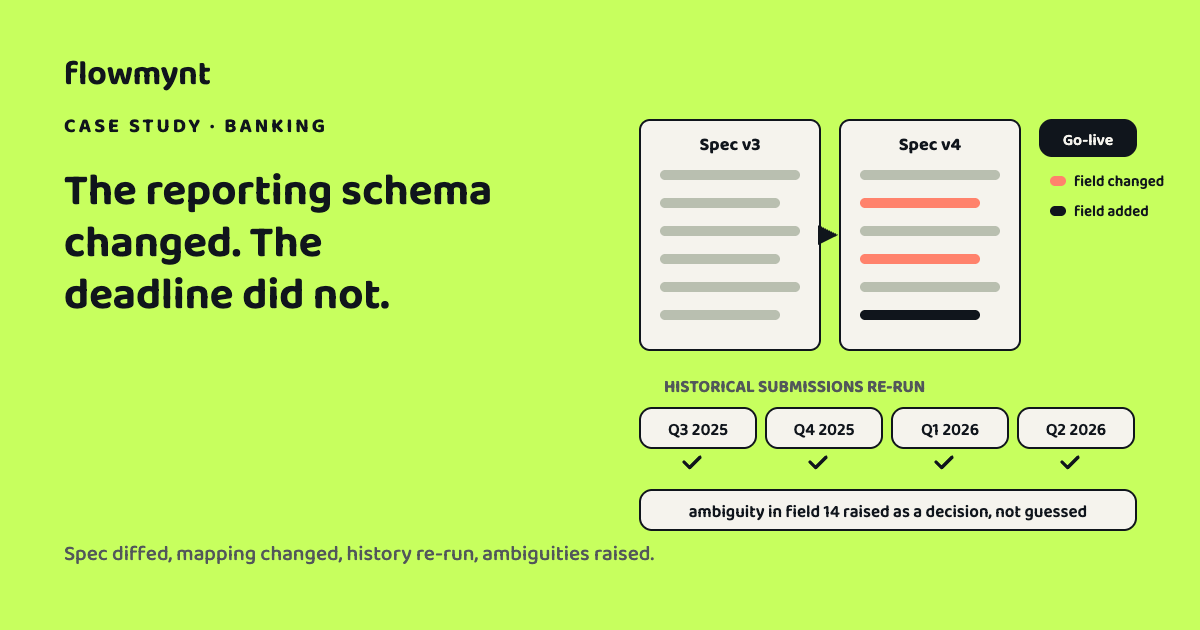
Four roles usually pass this work between them. Flowmynt runs it as one piece against one record: the specification is diffed, the mapping and rules change inside your systems, historical submissions are re-run as evidence, and an independent reviewer checks the exact revision that will be filed.
Diff the specification
The new specification is diffed against the current mapping and validation rules, and the work is broken into units with the passing standard attached to each.
Sequence
Mapping changes, rule changes and historical re-runs are sequenced as one run, with nobody assigning an analyst, a developer and a tester separately.
Build inside your systems
Mapping and rule changes are implemented on an isolated branch, inside the systems and permissions you granted.
Independent review
A reviewer who did not write the change reviews it against the exact revision produced.
Prove
The validation suite runs over representative historical submissions, and the run is accepted only when that evidence meets your standard.
Raise, do not guess
Every ambiguity in the specification is put in front of you as a decision, with the options, rather than resolved by assumption.
What the bank receives
The bank receives a filing it can stand behind, and the record that shows why every field changed.
- A reviewed change with the mapping diff and the reviewer recorded against it.
- Validation output over historical submissions, captured as the run happened rather than assembled afterwards.
- Specification ambiguities raised as decisions for you, not resolved by a guess.
What the bank decides
Flowmynt implements the interpretation you choose. Reading the regulation, agreeing it with the supervisor and choosing when to file are decisions the bank keeps, with every ambiguity raised in time to decide.
- Interpretation of the regulation.
- Sign-off with the regulator.
- Submission timing.
Where this lives in Flowmynt
Flowmynt Operate brings transaction activity, exceptions and reporting into one operating layer, so a reporting change is a mapping change on data that is already structured and traceable. Every figure in a submission can be followed back to the events that produced it.
For banks running their own reporting stack, Flowmynt does the same work inside it, with the evidence in your repository.
Source pattern: regulatory reporting changes, Exekova banking use cases
Is a specification change on your desk?
Send the specification and the affected report. Flowmynt replies with the diff against your current mapping and a plan to the submission date.
Talk to Flowmynt